Tuesday, April 13, 2010

Into the Stone Forest

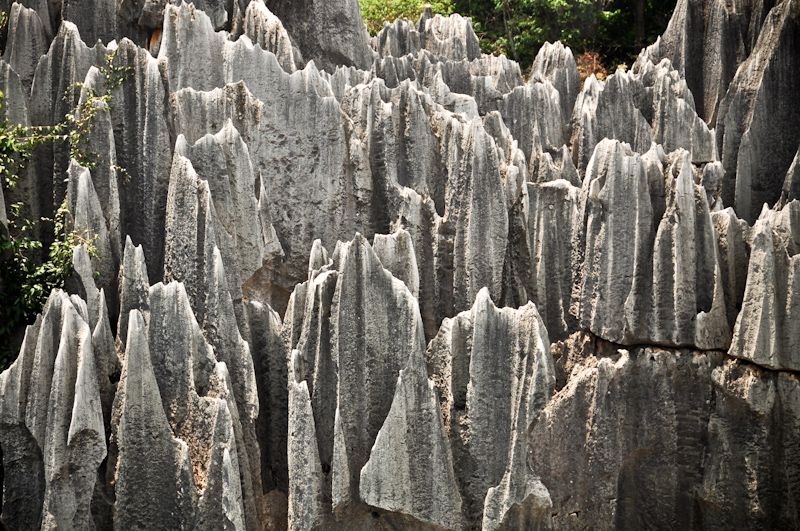
It was a fairly relaxing day. The only thing on my agenda was to see Shilin, the "Stone Forest." It's about a 120 kilometers outside of Kunming. Luckily there are direct buses that go to the area and it was fairly easy to get to.

Shilin was on my agenda when I first thought about what I was going to do in China. I thought it would be similar to Tsingy de Bemaraha National Park in Madagascar, which I saw a documentary on and found quite fascinating. I believe both were formed in the same manner of erosion, however, I think Shilin is considerably smaller in comparison and quite a bit more popular with tourists.

Unfortunately, the Shilin "Stone Forest" is so modified for accessibility, that it loses its natural appeal. Pathways run throughout the park, often right through the formations. A couple view points have been installed right on top of the formations where mostly domestic tourists gather shoulder to shoulder to try and get a good birdseye view and a photo of themselves with the formations in the background. For what it is, it's quite overpriced. So far it's the most I've paid for admission, even more than The Great Wall.

Perhaps the high ticket cost was to pay for the dancers. The park had two stages where the Yi people, dressed in traditional garb, performed various styles of dance. I took a few photos and hopped back on the bus to Kunming.

Later I met up with Ed and Christine, who I've now met up with in three places in China. We went out for "across the bridge" noodles, a speciality among these parts. I'm not sure it was my favorite dish, but it's always fun to try the local cuisine. We finished the night off with some ice cream and smoothies.

Shilin Stone Forest:


Yi People:

Monday, April 12, 2010

Kunming

I left Shangri-La early this morning, caught a flight straight to Kunming. I could have gone by bus, but I didn't feel like a fifteen hour bus ride. A one hour flight was more to my liking and worth the extra money. I figure the less I spent on the bus or train, the more I can spend sight-seeing.

I really didn't think about spending too much time in Kunming. It's a city of just over a million people and the capital of the Yunnan province. Reading the guidebook, there wasn't too much in the city I wanted to see, but to get to my next destination, it was a required stop.

I spent most of the day exploring and found it a fairly easy place to walk around. I must have walked a good portion of the city today. Everything seems fairly new. Malls, McDonalds and KFC are everywhere, though I did see an occasional row of old wooden buildings hidden in alleyways.

Kunming has a large Chinese Muslim population (known as the Hui) and a couple of sights indicated in the guidebook were mosques. I was pretty impressed with the architecture of mosques I've seen in the past, while traveling through India and the Middle East. These ones here were so ordinary that I actually walked right by. I don't know why they were indicated in the guidebook. I suppose just because it's unique to see a mosque in this area.

I also visited two pagodas which seemed to be quite old and the Yuantong Temple, which was the only sight I spent a bit of time at. The temple is quite pretty and much bigger than I thought. Spending some time on its grounds was a nice escape from the very noisy city streets.

Perhaps my favorite thing about Kunming has been the number of bakeries I've come across. I've filled up on a whole bunch of unique baked goods. The most interesting was a sweet pastry that had a muffin like bottom and a fried egg on top.

East Pagoda:


Old and new:


Yuantong Temple:


Unimpressive Mosque:


Kunming Downtown:

Sunday, April 11, 2010

Shangri-La

This morning I got up early, had breakfast and went out to the road to wait for a bus. There isn't an official bus stop here, but the buses do stop frequently. I was accompanied by an Australian couple and at the stop was an English guy. We waited for sometime and when a bus finally did come, it drove right past us. While we were waiting, a guy tried to offer us a ride for 250 yuen. I offered him 200 (50 each) and we were on our way.

The destination was Shangri-La, which is actually a fictional name for Zhongdian. James Hilton's Lost Horizon book is where the name comes from. No one knew he actually based it on a real place. There are actually a few places in the region that claim the name, but according to my guidebook this is actually the place. It's assumed he read about in an early National Geographic article published by Joseph Rock, a famous botanist that had spent years in this area. To attract tourists Zhongdian has now officially been renamed to Shangri-La.

The place is quite beautiful. At 3,200 meters above sea level, it's the highest town I've stayed in. I left my things in the hostel and went out to see as much of the town as I could. While running around, I ran into a Canadian couple that I had met in Lijiang, Ed and Christine. I found out they were going to the Ganden Sumtseling Gompa, a monastery that houses over 600 Tibetan monks. I asked if I could tag along as I was planning to go to the same place.

Going with them was excellent. Christine speaks Mandarin and she was also meeting up with a friend who lives here, so I got to learn quite a bit about the area, people and monastery. We walked around it for most of the day. A lot of it seems to be getting a facelift, which is too bad because I like that older look for the pictures. The monks here are apparently quite well off, they receive pretty good donations from businesses, in exchange for blessings.

The highlight of the day was at the end of our walk. We were invited by a monk into his home. Inside he had us sit around a stove and brought out a plate of baked goods, yak cheese and nuts. Jokingly he offered us some yak milk tea and brought out a bottle of Sprite. We learned a little about him and how he lives in the monastery. It was quite a nice experience.

After the monastery, I went out for dinner with Ed and Christine. We decided to have hot pot, as I had not tried it yet, as well as a few dumplings and pig leg, a local specialty. It was all very delicious.

Shangri-La Town:


The Monastery:


Saturday, April 10, 2010

Tiger Leaping Gorge

I'm in Qiaotou right now, the town where most people begin the hike to Tiger Leaping Gorge. I arrived here last night, on a bus that I wasn't sure was going in the right direction. Several times I tried to make sure I was on the right bus, but no one spoke English. I managed to say the name of the town enough times that when we actually got to it, people urged me to get off. There are very few direct buses here, most stop on the way to other places.

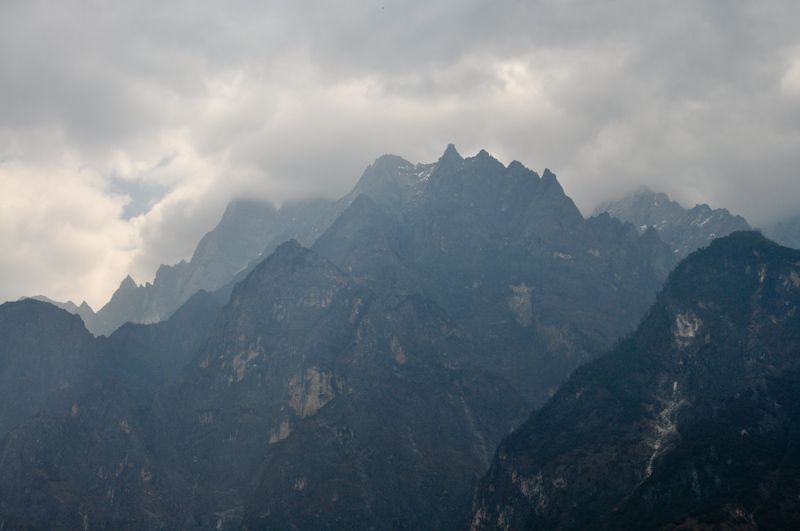
The thing to do here is hike the Tiger Leaping Gorge. Named so because there is a fable that a tiger leaped across the river at some point long ago. The hike is normally done over a course of two to three days, but looked at the map and the distances, I was sure I could do it over one and catch a car back to the town. The hotel owner was doubtful.

I started the hike a little after 9:00am. The first obstacle was the ticket booth. The hike trail is supposed to be free right now, because of the construction that's going on in the area, but the ticket booth was a little old lady that was swearing up and down that an admission of thirty yuen. I told her I would give her thirty yuen if she could give me a ticket for the hike. Of course she didn't have any tickets, she was just trying to take advantage of gullible tourists.

I continued on at a pretty good pace and passed a few people who had left earlier. The scenery was great, though not quite what I thought it would be. What I wasn't expecting were the the number of villagers I encountered along the way. The hike passes through two villages proped up on the steep hillside.

I reached the destination, a restaurant along the road, at a little over 3:30 pm. With time to spare, I decided to hike down to the water. This actually added an additional two hours to the hike, but it was well worth it. You really appreciate the size of the gorge from the very bottom. Once I climbed back up to the restaurant and arranged for a car to take me back to town.

The ride back to town was quite an experience. The road to the restaurant is being overhauled. The construction involved blowing up some of the rock and there was a ton of debris along the road. The driver would often get out of the car to clear rocks. There were also a ton of construction vehicles blocking the road and our driver would try to get around them along some very steep cliffs. The vehicle we were in had very little clearance and I was quite shocked that we were able to make it back to town with the car still in one piece.

Villagers:


Scenery:


Friday, April 9, 2010

Around Lijiang

MonkI'm so sore! I rented a bicycle today and biked around Lijiang. I should have taken it for a test ride first, as the seat was most uncomfortable. I'm having trouble sitting today. Other than that it was a wonderful day.

My first stop was the Fuguo Monastery. It was purely coincidental, as I meant to go to the Baisha Village and got lost. The guidebook described Fuguo as nothing but ruins, destroyed by the earthquake that struck the area in 1996. I figured it would at least have good views. As I biked up a seemingly never-ending hill, I was starting to have second thoughts about seeing it.

When I got there, I noticed there were no ruins; the temple seems to be getting rebuilt. I decided to check out the farm house that was next to it. As I approached it, before I even got off my bike, an old man ran out of the farm house screaming "Nice to meet you!" He grabbed my bike and started walking off with it. I followed curiously. He set it against the wall and waved me inside the house.

Inside the house, he offered me a seat at a table and brought out some tea. Looking around, I noticed that the farm house seemed transformed into a make-shift temple and the old man was a monk. After a couple of cups of tea, he gave me some incense to light and started praying. I knew he would ask me to donate some money and normally I would have stopped him, but I was happy to donate as not only did he give me tea, but I also got some neat photos from the whole thing.

Just next to the Fuguo Monastery, I noticed a little peak with a whole bunch of prayer flags. I locked up my bike and hiked up to it. As I got higher, I noticed the flags were everywhere! It made me wonder if this was done sometime after the earthquake. From the top I had some nice views of the valley and Lijiang.

Afterwards I rode to the Baisha Village and the Jade Peak Monastery (Yufeng Si). The village offered an insight into the daily grind of the Naxi People. Jade Peak Monastery was neat too as it seemed to be more of a Tibetan type, which prayer wheels all over the place. The highlight of the day was definitely my Fuguo Monastery experience.

Lijiang in the morning:


Fuguo Monastery:


Views of the valley:


Jade Peak Monastery